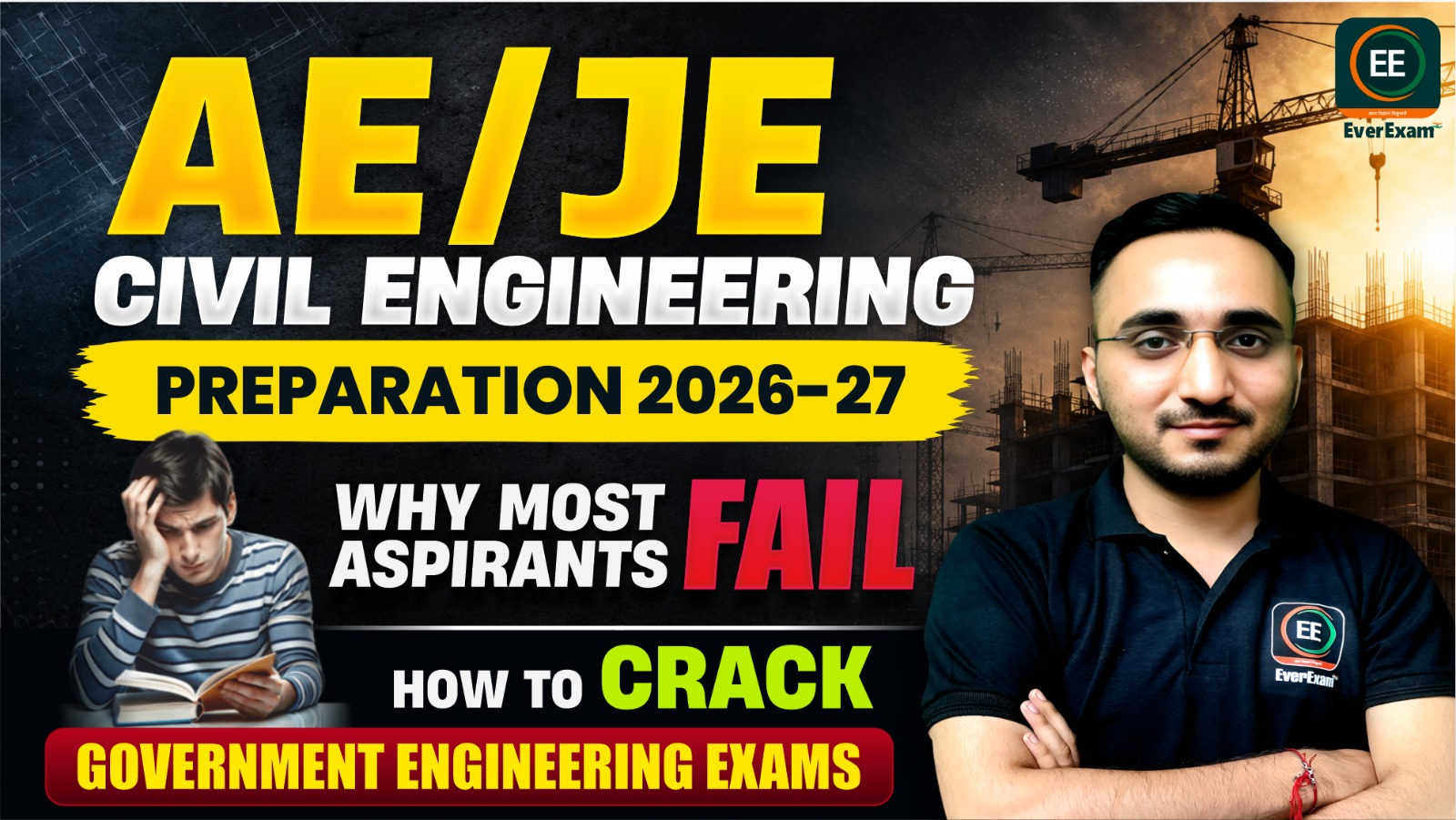
Why Most Civil Engineering Aspirants Fail in AE/JE Exams (And How to Avoid It in 2026-27)
Every year, lakhs of Civil Engineering graduates apply for government engineering examinations such as SSC JE, RRB JE, State JE, State AE, Coal India MT, and various PSU recruitments. The opportunities are plenty, the vacancies are announced regularly, and the dream of securing a stable government engineering job attracts thousands of aspirants.
Yet, despite having the required qualification and access to countless study resources, many candidates find themselves preparing for the same exams year after year without achieving the desired result.
If you've ever wondered why this happens, the answer is surprisingly simple.
Most candidates don't fail because they are less intelligent. They fail because they spend months studying without a clear strategy.
The good news is that this mistake can be avoided.
In this article, we'll discuss the reality of AE/JE preparation, the common mistakes aspirants make, and a practical roadmap that can help Civil Engineering students prepare more effectively for government engineering exams in 2026-27.
The Biggest Myth About AE/JE Preparation
One of the most common beliefs among aspirants is:
"If I study for long hours every day, I'll definitely crack the exam."
Unfortunately, preparation doesn't work that way.
Many candidates study for 8-10 hours a day but spend most of that time:
- Watching random lectures
- Collecting study materials
- Making lengthy notes
- Switching between multiple books
- Following different strategies every week
At the end of several months, they realize they have covered a lot of content but haven't actually prepared for the examination.
Competitive exams reward focused preparation, not just hard work.
The goal should not be to study more.
The goal should be to study smarter.
📞Contact Us Now: 👆Tap to Call for SSC JE 2026-2027 Civil Engineering Syllabus Assistance
Why Civil Engineering Aspirants Often Feel Overwhelmed
Civil Engineering is one of the broadest engineering disciplines.
A typical aspirant preparing for AE/JE exams needs to cover subjects such as:
- Strength of Materials
- RCC
- Structural Analysis
- Steel Structures
- Fluid Mechanics
- Soil Mechanics
- Environmental Engineering
- Transportation Engineering
- Surveying
- Building Materials
- Hydrology
- Irrigation Engineering
When candidates look at the entire syllabus together, it often feels impossible to complete.
This is where many students lose confidence.
What they don't realize is that successful candidates don't study everything at once.
They break preparation into manageable stages.
TAP NOW👉 ENROLL IN SSC JE 2026-2027 BATCH 👈TAP NOW
The Four Stages of Successful AE/JE Preparation
Every successful aspirant follows a preparation journey that can be divided into four stages.
Stage 1: Build Strong Fundamentals
This is where preparation actually begins.
Before solving thousands of MCQs, candidates must understand the concepts behind them.
For example:
- Why does a beam fail?
- What affects soil bearing capacity?
- How does fluid pressure behave under different conditions?
Understanding concepts helps candidates solve unfamiliar questions with confidence.
Students who focus only on formulas often struggle when the question pattern changes.
Strong fundamentals remain useful across every engineering examination.
Stage 2: Practice Questions Consistently
Learning concepts is only half the battle.
The next step is applying them.
This is where question practice becomes important.
After completing any topic, candidates should immediately solve objective questions related to it.
Benefits of regular question practice include:
- Better concept retention
- Improved speed
- Increased accuracy
- Familiarity with exam patterns
The more questions you solve, the more comfortable you become during the actual examination.
📞Contact Us Now: 👆Tap to Call for SSC JE 2026-2027 Civil Engineering Syllabus Assistance
Stage 3: Revision
This is the stage most aspirants ignore.
Many students complete a subject and move on to the next one without revisiting what they have already studied.
A few weeks later, they realize they have forgotten a significant portion of the syllabus.
Revision is not optional.
It is one of the most important parts of preparation.
A simple revision strategy can include:
- Daily revision for 30 minutes
- Weekly revision sessions
- Formula notebooks
- Short notes for important concepts
Candidates who revise regularly often outperform those who continuously study new topics without revision.
TAP NOW👉 ENROLL IN SSC JE 2026-2027 BATCH 👈TAP NOW
Stage 4: Mock Tests
Mock tests are where preparation meets reality.
They help candidates understand:
- Time management
- Accuracy levels
- Weak subjects
- Exam temperament
Many aspirants avoid mock tests because they are afraid of scoring poorly.
However, low scores during preparation are not a problem.
The real problem is discovering weaknesses on the actual exam day.
Mock tests provide an opportunity to identify mistakes before the examination.
What Toppers Do Differently
If you analyze the preparation habits of successful candidates, you'll notice some common patterns.
They Focus on Concepts
Rather than memorizing hundreds of formulas, they understand the logic behind them.
They Solve Previous Year Questions
Previous year questions help them understand the examiner's mindset and identify important topics.
They Revise More Than Average Aspirants
Most candidates spend their time learning new topics.
Toppers spend a significant portion of their preparation revising old ones.
They Track Their Progress
They regularly evaluate their performance through practice tests and mock exams.
They Stay Consistent
Perhaps the biggest difference is consistency.
Successful candidates don't rely on motivation.
They follow a routine even on days when they don't feel motivated.
TAP NOW👉 ENROLL IN SSC JE 2026-2027 BATCH 👈TAP NOW
A Practical Preparation Roadmap for 2026-27
Instead of worrying about the entire syllabus, focus on one phase at a time.
Phase 1: Foundation Building
Duration: 2-3 Months
Focus Areas:
- Core Civil Engineering subjects
- Concept clarity
- Basic numerical practice
Phase 2: Intensive Question Practice
Duration: 2 Months
Focus Areas:
- Topic-wise MCQs
- Previous year questions
- Weak subject improvement
Phase 3: Revision and Consolidation
Duration: 1 Month
Focus Areas:
- Formula revision
- Short notes
- Important concepts
Phase 4: Mock Test Phase
Duration: Final Month
Focus Areas:
- Full-length tests
- Time management
- Error analysis
This structured approach makes preparation more manageable and less stressful.
TAP NOW👉 ENROLL IN SSC JE 2026-2027 BATCH 👈TAP NOW
The Problem With Studying From Too Many Sources
Many aspirants believe that more resources lead to better preparation.
In reality, the opposite is often true.
Switching between multiple books, notes, and courses creates confusion.
Instead of mastering one resource, candidates keep starting over.
A better approach is:
- Choose one reliable source for each subject.
- Complete it thoroughly.
- Revise it multiple times.
- Practice questions regularly.
Depth is more valuable than quantity.
Why Guidance Matters
Preparing alone is possible.
However, guidance can significantly reduce the time required to identify important topics, avoid mistakes, and stay on track.
Many candidates spend months figuring out what to study, when to revise, and how to practice.
A structured preparation environment removes much of this uncertainty
This allows students to focus more on learning and less on planning.
📞Contact Us Now: 👆Tap to Call for SSC JE 2026-2027 Civil Engineering Syllabus Assistance
How Everexam Supports Civil Engineering Aspirants
At Everexam, the objective is simple:
Help Civil Engineering aspirants prepare in a more structured and exam-oriented manner.
Instead of focusing only on syllabus completion, the emphasis is placed on the complete preparation cycle.
Concept-Focused Learning
Strong fundamentals remain the foundation of every successful preparation journey.
Quick Revision Programs
Designed to help students revise large portions of the syllabus efficiently before examinations.
Question Practice Sessions
Regular problem-solving sessions help improve speed, accuracy, and confidence.
Previous Year Question Discussions
Understanding frequently asked concepts and examination trends.
Mock Tests and Performance Analysis
Helping candidates identify weak areas and improve their overall exam performance.
The goal is not simply to study more, but to prepare better.
Final Thoughts
Every year, thousands of Civil Engineering aspirants begin their preparation journey with high expectations.
Some lose direction midway.
Some become overwhelmed by the syllabus.
Some keep waiting for the "perfect time" to start.
The candidates who ultimately succeed are rarely the ones who know everything.
They are the ones who build strong fundamentals, practice consistently, revise regularly, and stay disciplined throughout the process.
Government engineering examinations are not won through shortcuts.
They are won through systematic preparation and consistent effort over time.
If you're planning to prepare for AE/JE examinations in 2026-27, start today, trust the process, and focus on improving a little every day.
A year from now, you'll be grateful that you started when you did.
TAP NOW👉 ENROLL IN SSC JE 2026-2027 BATCH 👈TAP NOW
Online Live Batches by Everexam | Grab Now |
Batch Name | Explore Link |
SSC JE Pre to Mains 2026 –(Civil) | |
Best Question Practice –(Civil) | |
RRB JE –(Civil) | |
UPPSC AE batch-(Civil) |
📞Contact Us Now: 👆Tap to Call for SSC JE 2026-2027 Civil Engineering Syllabus Assistance